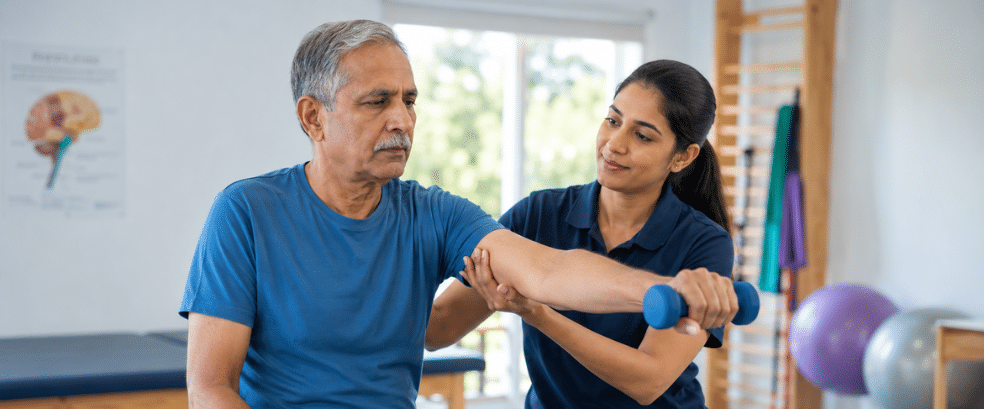
Stroke recovery does not follow a straight line, and this is one of the most poorly explained parts of the entire process. Families are often told that recovery happens in the first few months and then plateaus, which creates a lot of anxiety once that window passes and progress slows down. The reality is more specific than that. Recovery happens in stages, each with a different focus, and physiotherapy plays a different role at each one. Understanding what is realistic at each stage helps families set expectations that match how the body actually heals, rather than expectations shaped by a rough timeline someone once mentioned.
Why Stroke Recovery Is Different From Other Physiotherapy Cases
Most physiotherapy deals with a specific muscle, joint, or movement pattern that has gone wrong. A stroke is different because the injury is in the brain, not the body part itself. This means the arm or leg that is not moving properly is often not actually damaged, it is the brain’s ability to send the correct signal to that limb that has been disrupted. For example, a person may have a leg with completely normal muscle strength when tested passively, yet be unable to lift it properly during walking because the signal coordinating that movement is not getting through cleanly. This is why stroke physiotherapy focuses heavily on retraining movement patterns and helping the brain form new pathways, rather than simply building strength in the way a sports injury rehabilitation would.
The Early Stage: The First Few Weeks
What the Body Can and Cannot Do Yet
In the early stage after a stroke, movement is often very limited, and muscle tone can be either very low, making the limb feel floppy, or very high, making it stiff and resistant to movement. Both are common and neither is a fixed outcome. Early physiotherapy at this stage focuses on preventing complications rather than pushing for big movement gains, since the joints and muscles need to be kept from stiffening up while the brain begins reorganising itself.
Why Positioning and Small Movements Matter More Than They Seem
A lot of early stage physiotherapy looks deceptively simple from the outside, adjusting how someone is positioned in bed, helping with small assisted movements, or working on sitting balance. This stage is often underestimated by families who expect visible progress like walking again. In reality, a person who is positioned and moved correctly in these early weeks tends to have significantly better long-term outcomes than someone who was left immobile, even if the early sessions themselves look unremarkable.
The Middle Stage: Where Most of the Visible Progress Happens
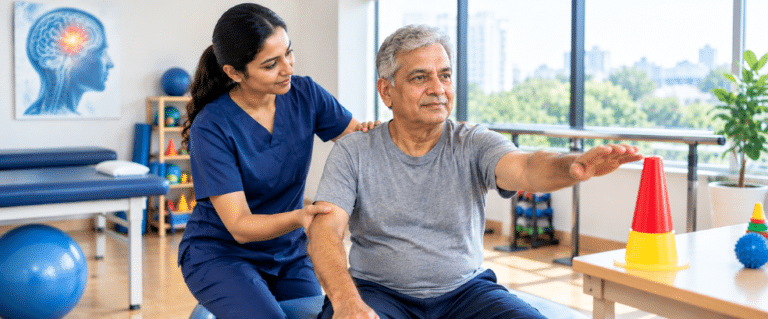
This is usually where families start seeing the changes they were hoping for, regaining the ability to sit unsupported, stand, take steps with support, or use an affected hand for simple tasks. Progress in this stage tends to be faster and more visible, which is also why some families assume this pace will continue indefinitely. It generally does not, and that is a normal part of the process rather than a sign that something has gone wrong.
Relearning Movement Versus Building Strength
A key judgement call during this stage is figuring out whether a movement difficulty is because a muscle is genuinely weak, or because the brain has not yet relearned how to coordinate that movement correctly, even though the muscle itself works fine. These require different approaches. Treating a coordination problem as if it were a strength problem, for instance by only giving resistance exercises, often produces very slow or disappointing results, because the actual issue was never about muscle power in the first place.
The Later Stage: When Progress Slows Down
Progress does slow down considerably after the first several months, and this is where a lot of families become discouraged, sometimes assuming recovery has stopped entirely. It has not stopped, it has simply moved from large, fast changes to smaller, slower ones, such as improving the quality and efficiency of a walking pattern rather than gaining entirely new movement. This stage is often where physiotherapy has the most long-term value, since it is focused on making whatever movement has been regained more functional and safer for daily life, reducing fall risk, and building the stamina needed for real-world activity rather than just clinic-based exercises.
Why Physiotherapy After a Stroke Works Best Alongside Ongoing Medical Input
Stroke recovery is rarely a physiotherapy-only process, particularly in the early months when medical factors such as blood pressure control, medication adjustments, and monitoring for further vascular events are still actively being managed. At Ragav’s Brain and Spine, physiotherapy for stroke patients is coordinated directly with the in-house neurosurgeon, Dr Sudharsan P V, so that changes in a patient’s condition are communicated immediately rather than discovered weeks later at a separate follow-up appointment. This is particularly relevant when a patient’s progress unexpectedly plateaus or reverses, since that can sometimes signal a medical issue rather than a physiotherapy one, and having both under the same roof means that distinction gets made quickly.
Frequently Asked Questions
How soon after a stroke should physiotherapy start?
Physiotherapy generally starts as early as a patient is medically stable enough for it, often within the first few days of hospital admission. Earlier appropriate movement is generally associated with better long-term outcomes compared to prolonged immobility.
Is it normal for stroke recovery to slow down after a few months?
Yes, this is a normal pattern rather than a sign that recovery has failed. Large, visible gains tend to happen in the first several months, after which progress continues at a slower, more gradual pace focused on refining movement and function.
Can physiotherapy help even years after a stroke?
Yes. While the fastest gains usually happen earlier, physiotherapy can still improve movement quality, strength, balance, and daily function years after a stroke, particularly if consistent therapy was not available earlier.
Why does my family member’s arm or leg feel stiff instead of weak?
This is often related to changes in muscle tone caused by the brain injury itself, rather than a problem with the muscle. This kind of stiffness needs a different physiotherapy approach than simple weakness, which is why an accurate assessment early on matters.
What is the difference between physiotherapy and occupational therapy after a stroke?
Physiotherapy generally focuses on movement, strength, balance, and walking, while occupational therapy focuses on relearning daily activities such as dressing, eating, or using a bathroom safely. Both often work together during stroke recovery.
Does someone need to relearn walking from scratch after a stroke?
Not always from scratch, but the walking pattern often needs to be retrained since the brain’s coordination of the movement has been disrupted, even if the muscles themselves are not significantly weakened.
If you or a family member is going through stroke recovery and want a proper physiotherapy assessment in Whitefield, Bengaluru as part of that process, get in touch to discuss the right next steps.